
Aviator rounds last about 8 to 30 seconds. The game usually produces 60 to 90 rounds per hour, with a pause of a few seconds between rounds.
That pace changes how quickly a balance can move. A short round can seem easy to follow, but repeated stakes can add up when many rounds arrive in one hour. This article focuses on round length, the pause between rounds, and what the pace means for a session budget.
Aviator Round Length
Aviator rounds last about 8 to 30 seconds. Each round starts with an increasing curve and ends when the crash point is reached.
The multiplier begins at 1.00x and rises during the round. A player must cash out before the crash to receive the multiplier shown at that moment. If the crash arrives first, the bet loses. The crash point is fixed before take-off.
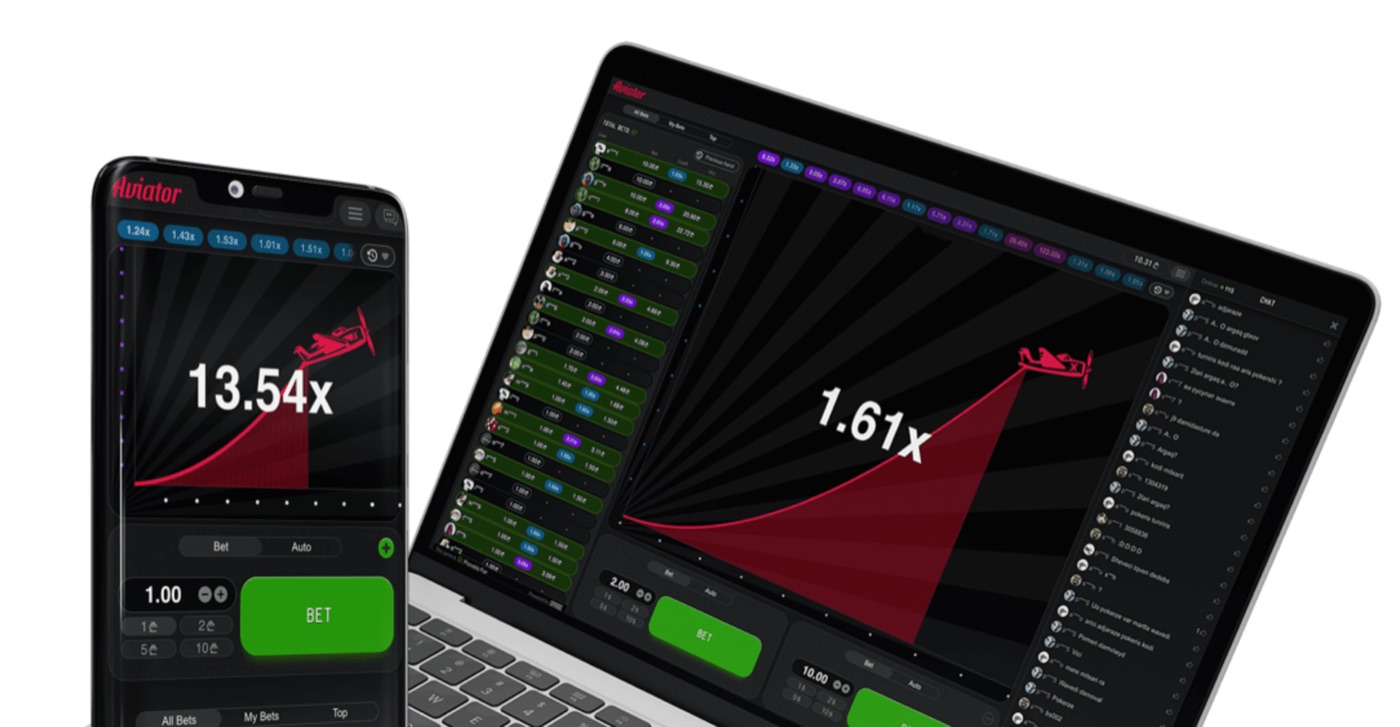
The Aviator interface can show different live multipliers on a phone and laptop.
Eight seconds and 30 seconds create different betting rhythms. An 8-second round leaves little time for a decision after take-off. A 30-second round gives the multiplier more time to rise, but it does not make a later cash-out more likely.
- An 8-second round can finish before a player reacts to a planned target.
- A 15-second round sits near the middle of the stated range.
- A 30-second round can occupy more time without changing the house edge.
The round length does not reveal the next crash point. Short and long rounds are both part of the same game. A previous result also does not set the duration of the next round.
Aviator is a crash game, not a slot. It has no bonus round. Its main timing question is simple: how many rounds can fit into the time available for the session?
Rounds Per Hour
Aviator produces about 60 to 90 rounds per hour. The difference between those figures comes from round duration and the pause between rounds.
At 60 rounds per hour, one round cycle averages about one minute. At 90 rounds per hour, one round cycle averages about 40 seconds. These figures include the round and the gap before the next round, so they describe the pace of the session rather than only the flight.
| Rounds in one hour | Average cycle time | Meaning for a session |
|---|---|---|
| 60 | About 60 seconds | Fewer betting decisions in the hour |
| 75 | About 48 seconds | Middle pace between the stated limits |
| 90 | About 40 seconds | More betting decisions in the hour |
The table does not predict a precise schedule. Actual pacing depends on how long rounds run and how long the game takes to move into the next round. The operator can also affect the practical experience through the website or app connection, but the stated game range remains about 60 to 90 rounds per hour.
- Count the rounds you expect to watch or play.
- Multiply that count by the planned stake.
- Compare the total with the amount set aside for the session.
For example, a $1 stake on every round would expose $60 to $90 of stakes over one hour if every round received that stake. That is total stake turnover, not a guaranteed loss. Aviator has a 97% RTP and a 3% house edge, so the expected value is -3% of the stake at every cash-out target.
The expected value does not remove short-term variation. Aviator is a high-variance game. A session can finish above or below the expected result, while the pace still determines how quickly bets are placed.
Pauses Between Rounds
Aviator has a pause of a few seconds between rounds. That pause separates one crash point from the next betting opportunity.
The gap is short enough to support a continuous session. It is also long enough for a player to review the last multiplier, change a stake, or decide not to enter the next round. The pause is not a signal about the next result.
The interface shows the previous multipliers in the round history at the top. This display records earlier outcomes, but it does not change the probability of a new round. Rounds are independent.
- A 1.00x crash does not make a higher multiplier due.
- A 10x result does not make a short round more likely next.
- A long pause does not improve the next cash-out chance.
- A fast sequence does not create a pattern that changes the odds.
Players sometimes use the pause to read the chat or the live bets panel. Those panels show activity from the current game, not a forecast of the next crash point. The same applies to the history of previous multipliers.
Playing off-peak may provide a smoother connection, but it does not improve the odds. The pause can help with attention and control, yet it cannot create an advantage over the 3% house edge.
One practical issue is cash-out timing. The cash-out request must reach the server before the crash. A slow device or network latency can cause a time-out, and the pause before the next round cannot change a request that missed the deadline.
Session Budget And Pace
A $10 session budget supports ten $1 stakes if every round receives one bet. Ninety rounds can use that same budget much faster than 60 rounds when the stake is repeated without breaks.
The key number is not only the amount held in the account. It is the amount exposed per round and the number of rounds planned. A player who stakes $0.50 on 60 rounds exposes $30 in total stake turnover. At 90 rounds, the same repeated stake exposes $45.
These totals do not predict the final balance. They show how quickly a planned stake can be used. The 97% RTP applies over the game’s mathematical model, while any one session can vary because results are independent and the game has high variance.
- $0.50 for 60 rounds equals $30 in total stakes.
- $0.50 for 90 rounds equals $45 in total stakes.
- $1 for 60 rounds equals $60 in total stakes.
- $1 for 90 rounds equals $90 in total stakes.
A player can also use a round limit instead of a time limit. For example, a 20-round session fixes the number of betting opportunities, while a 15-minute session allows the number of rounds to vary with the pace.
Budget Examples
Consider a $20 budget and a $1 stake. If the player plans 20 rounds, the full budget covers the planned stake turnover. If the player plays for an hour at 60 to 90 rounds, the same budget cannot cover $1 on every round without adding funds or changing the stake.
Now consider a $30 budget and a $0.50 stake. The planned stake turnover covers 60 rounds. At the faster end of the normal pace, 90 rounds would require $45 in repeated stakes, which is $15 above that planned amount.
These examples do not recommend a stake size. Typical stakes range from about $0.10 to $100 per bet, depending on the operator. The operator also sets any win caps per round, so the amount available for a particular bet depends on the bookmaker’s rules.
- Choose the money available for the session.
- Choose the number of rounds or minutes.
- Divide the budget by the planned number of bets.
- Stop when the budget or the chosen limit is reached.
Do not treat a higher target as a way to repair a loss. The expected value remains -3% of the stake at every cash-out target. Martingale, Fibonacci, and D’Alembert systems do not beat that edge.
For example, Martingale doubles the stake after each loss. After 10 losses, the next stake reaches 1,024 times the base stake. A short pause between rounds makes that sequence easier to place quickly, but it does not make the sequence safer.
Set a loss limit before betting and stop when it is reached. Only use money that can be lost without affecting essential spending.
Controls During A Round
Aviator provides two bet panels in each round. Each panel has separate cash-out controls, so a player can manage two bets independently.
The interface includes Bet and Auto tabs. Auto Cash-Out can use a preset multiplier, while Auto Bet or Auto Play can cover 10 to 100 rounds with stop-on-win or stop-on-loss settings.
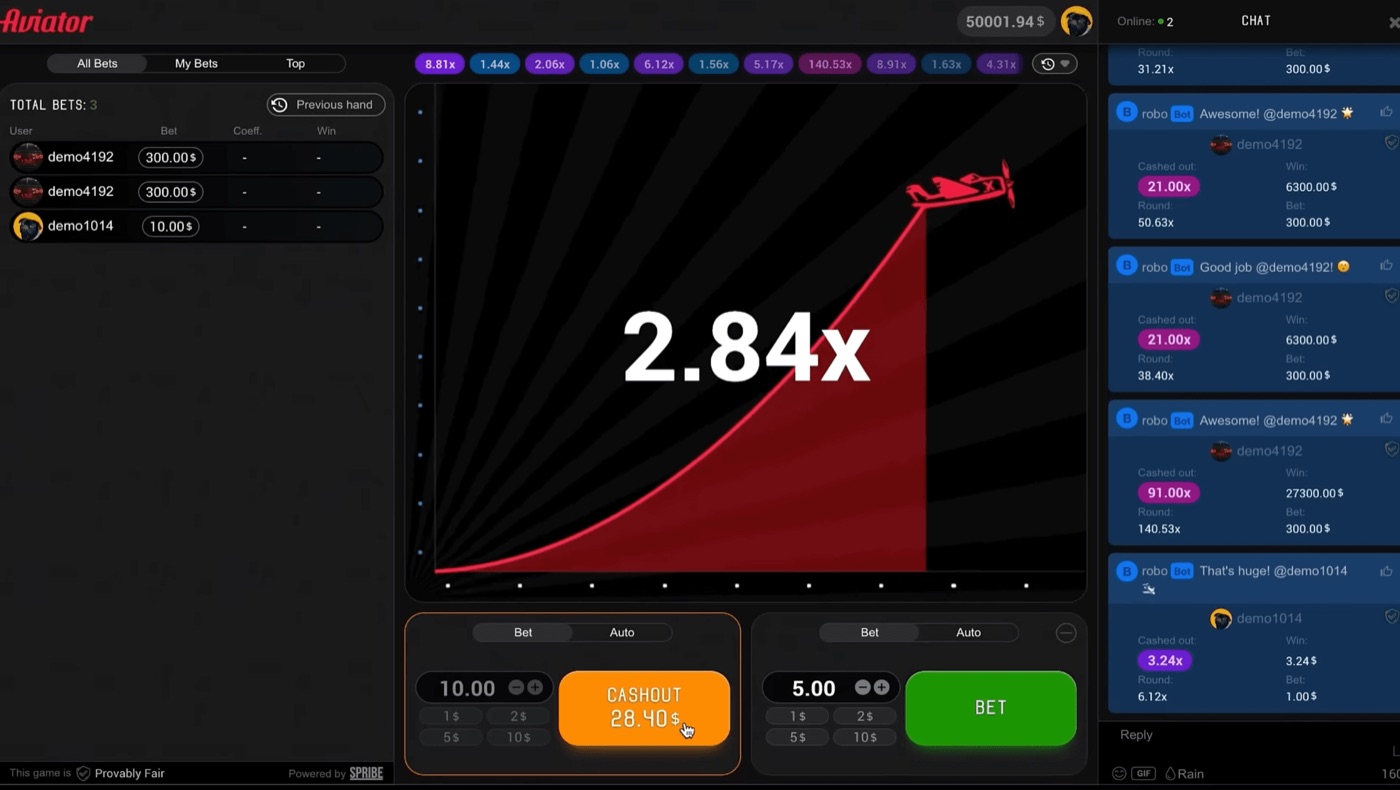
The interface combines live bets, chat and a cash-out displayed at 28.40.
Automation changes how bets are entered. It does not change the probability of reaching a multiplier. The preset remains a rule for placing or closing a bet, not a forecast of the crash point.
- Bet sets the stake for a manual entry.
- Auto Cash-Out closes a bet at a chosen multiplier when the round reaches it.
- Auto Bet or Auto Play can run for 10 to 100 rounds.
- Stop-on-win and stop-on-loss can end the automated sequence.
The two-panel design can also change total exposure. A $1 stake on each panel means $2 at risk in a round. Across 60 rounds, that repeated setup would create $120 in stake turnover. Across 90 rounds, it would create $180.
That example uses a fixed stake for arithmetic only. It does not account for wins, losses, cash-outs, or operator-specific limits. It shows why the number of active bet panels belongs in a session budget.
For a crash game, a multiplier target is also a timing choice. A 1.5x target may arrive earlier than a 10x target, but the chance of reaching each target differs. The probability of reaching multiplier m is 0.97 divided by m.
| Target | Probability of reaching it | Expected value of the stake at target |
|---|---|---|
| 1.5x | 64.7% | -3% |
| 2x | 48.5% | -3% |
| 5x | 19.4% | -3% |
| 10x | 9.7% | -3% |
For a gambling session, an aviator app install does not change the crash game’s multiplier, cash-out timing, stake, bookmaker rules, RTP or free bets. The game runs inside an operator website or app, and there is no standalone official Aviator app from Spribe.
Timing And Fairness
Spribe publishes a SHA-256 hash of the server seed before each round. The crash point is fixed before take-off, and the inputs are revealed after the round.
Players’ client seeds combine with the server seed. The verification tool inside the game can check the result after the round. Neither the operator nor Spribe can change a result after the round starts.
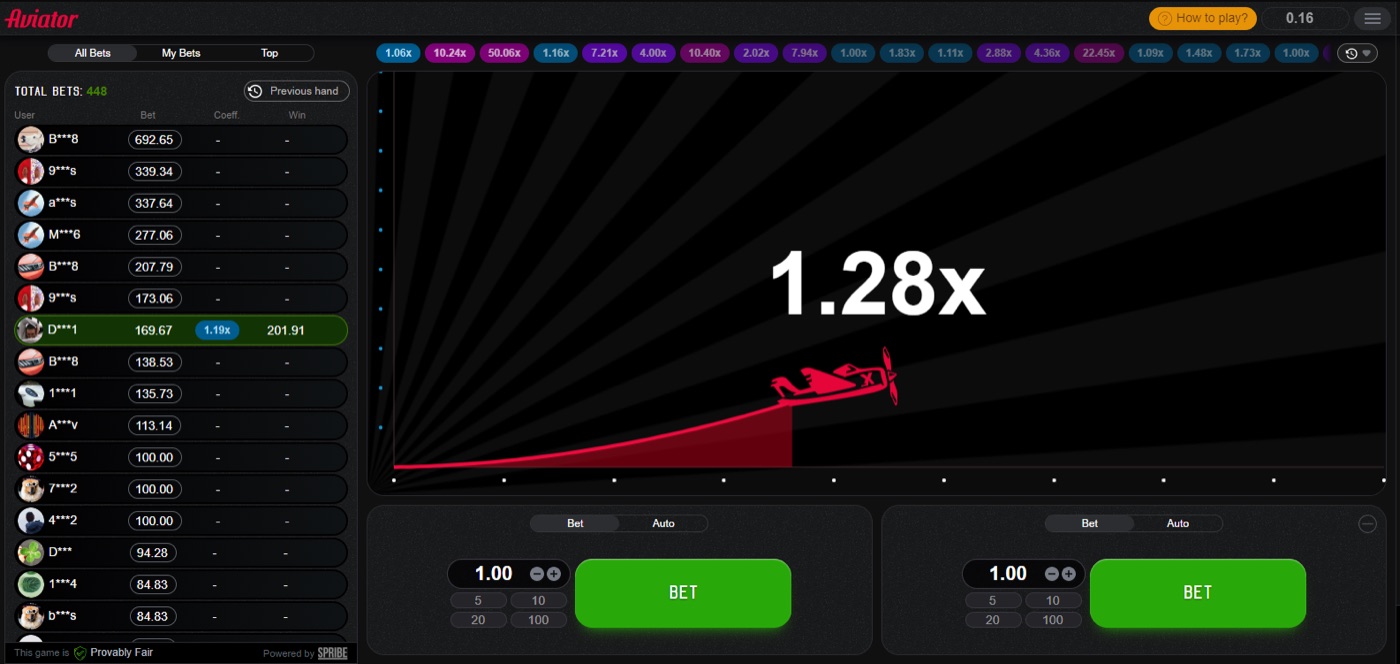
The plane is in flight while the Aviator multiplier rises before the crash.
This process explains why timing does not provide a prediction. The result is committed before the visible flight begins. Watching the first seconds, waiting through the pause, or comparing earlier round lengths cannot reveal the next crash point.
- The hash appears before the round.
- The crash point is fixed before take-off.
- The round result becomes checkable after it ends.
- The operator cannot alter the result after the start.
A 1.00x instant crash occurs in about 3% of rounds, or roughly one in 33. The probability of a 100x round is 0.97%. These figures describe the mathematical probabilities supplied for Aviator, not a schedule for when a result must appear.
Prediction apps and signal tools do not change this timing model. Public mathematics cannot identify a committed crash point before the round. Patterns, graph analysis, “best time to play” claims, and strategy charts do not change the odds.
Connection quality still matters to the cash-out request. A request that reaches the server after the crash cannot be completed, even if the player pressed the control before seeing the result on a slow device.
Aviator FAQ
Aviator rounds last about 8 to 30 seconds. The game produces about 60 to 90 rounds per hour, with a few seconds between rounds.
Those figures explain the main timing questions. They do not provide a method for predicting a crash point or removing the 3% house edge.
How long does an Aviator round last?
An Aviator round lasts about 8 to 30 seconds. The duration ends when the increasing curve reaches the crash point. The crash point is fixed before take-off, so the visible duration cannot be used to forecast the next round.
How many rounds can occur in one hour?
Aviator usually has 60 to 90 rounds per hour. The pace includes the short pause between rounds. A faster hour creates more betting opportunities and can use a repeated stake more quickly.
Does the pause predict the next multiplier?
No. The pause lasts a few seconds, but it does not signal a short or long next round. Rounds are independent, and previous multipliers do not change the probability of the next result.
How should timing affect a session budget?
Multiply the planned stake by the planned number of rounds. For example, $1 on 60 rounds equals $60 in stake turnover, while $1 on 90 rounds equals $90. Treat those amounts as exposure calculations, not guaranteed losses or returns.
Can an app predict the Aviator crash point?
No. The server publishes a SHA-256 hash before each round, and the crash point is fixed before take-off. Predictor apps and signal bots cannot identify that result in advance.
Why can a cash-out time out?
A cash-out request must reach the server before the crash. Latency or a slow device can delay the request, so the game may time out even when the player pressed cash-out before the result appeared on the screen.